
NEW ALBUM RELEASE IS COMING IN SPRING 2026. STAY TUNED!
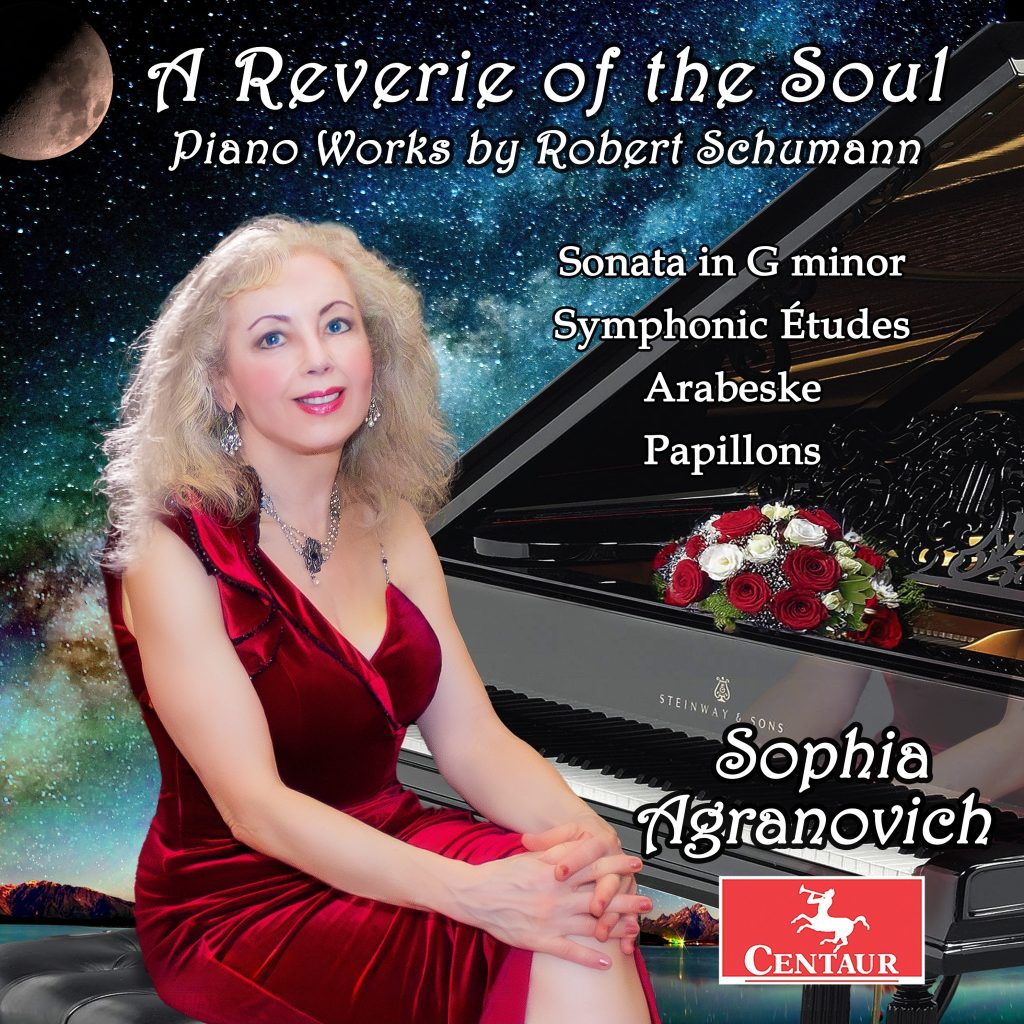
“Impeccable musicianship and beauty… Five stars.This is a Schumann recital to treasure.Very strongly recommended.” -Jerry Dubins, Fanfare Magazine Full Review
***
“This is Sophia Agranovich’s twelfth album. Each has revealed a virtuoso of uncommon technical accomplishment and a unique interpretive perspective. Many earlier releases have been reviewed here and critics have been unanimous in their positive reactions,, a fairly uncommon situation…”
“Agranovich is a high energy player who displays great intensity and is able to balance local detail with the long line to a degree fairly rare among contemporary pianists. Local rubato is applied generously, but a large-scale piece like the Symphonic Variations also reveals a carefully plotted overall narrative.“
“This is often thought to be one of the most difficult to play of Schumann’s piano works, but one would never guess that here; Agranovich is in complete control at all times. The theme is handled with great sensitivity. The fast sections, such as Variation 1 and Etude 3, feature superb clarity and crisp articulation. Variation 4 has a wonderfully light touch. Not all is powerful extroversion. Variation 9 really sings in its longer lines. The repetitious material in the Finale is nicely varied through control of dynamics and articulation.The G-minor Sonata receives a highly-charged interpretation, emphasizing contrast in the opening movement through imaginative phrasing. This is again in evidence in the second movement; the central section is beautifully done.”
“The Prestissimo Coda of the final movement is a real tour de force... The early Papillons is a work in a similar vein. The playfulness and fantasy of the piece are brought to the fore with an impressively wide gradation of touch. Phrasing is highly flexible throughout; bar lines simply disappear.“
“This is great Schumann playing. It belongs in the company of interpreters like Richter, Nat, Perahia—name your favorites.…. Highly recommended. Five Stars: a superb new entry in Agranovich’s expanding discography of Romantic masterworks.” –Michael Vaillancourt, Fanfare Magazine Full Review
***
“Supremely performed…the keystrokes are gloriously textured...Her touch here is exquisite, and is to be respected in its consistency…Stunning…incredibly intimate.”
“She has crafted her presentation of, A Reverie of the Soul: Piano Works by Robert Schumann to such a high standard, that the word glorious is simply not enough, this halcyon manifestation of brilliance shines light a beacon of hope on the horizon of modern classical piano performances.” -Steve Sheppard, OneWorld Music Radio Full Review
***
“A Reverie of the Soul is a release well worth having. Sophia Agranovich is an excellent Schumann pianist who makes her case for the bolder, more openly Romantic side of Schumann eloquently and well. Highly recommended. Five stars: Excellent collection of Schumann’s bolder, more impassioned piano pieces.” –Mark Gabrish Conlan, Fanfare Magazine
***
“A Reverie of the Soul: Piano Works by Robert Schumann is another brilliant work of art from Sophia Agranovich… Very highly recommended to classical music lovers and those who appreciate incredible piano performances!” -Kathy Parsons, MainlyPiano Full Review
***
“Agranovich’s gorgeous and eloquent rendering of the opening movement’s lyrical second theme is pure gold.… Agranovich plays beautifully, with each Étude accorded its individuality, all the while maintaining a sense of proportion and flow throughout the work…
The Arabeske and Papillons exude delicacy and songful poetry… Agranovich’s flexibility of phrasing, and willingness to linger over passages, evoke a bygone golden age of pianism. May there always be a place for this kind of music-making. On balance, a most lovely Schumann recital.” -Ken Meltzer, Fanfare Magazine
***
“This Schumann program is titled A Reverie of the Soul. It begins “as fast as possible” and ends with the fluttering of butterflies. Agranovich has a dozen CDs to her credit and more awards than imaginable, along with performances at most of the world’s major concert venues. Her Schumann is both brilliant and beautiful… incredible technical command… an outstanding performance.”
“Agranovich plays this beautiful rondo with a sense of “intimacy and emotional depth” as she writes in her excellent program notes… I have never heard this work played with as much imagination as here. Many, many Schumann piano recitals are in my library and it seems that more appear for nearly every issue. This one is special and will remain in my active listening stack for some time to come.”
Five stars: world-class performances of several of Schumann’s greatest piano works. -James Harrington, Fanfare Magazine Full Review

This album expresses the heart of Romanticism that celebrates Robert Schumann at his most visionary, intimate, and electrifying. It features some of Schumann’s most beloved works, revealing the full spectrum of his poetic imagination and virtuosic fire. The Piano Sonata No. 2 surges with restless energy and dramatic contrasts, where heroic gestures collide with moments of haunting introspection. In the Symphonic Études, dazzling virtuosity meets profound emotional depth, each variation unfolding like a character in a psychological drama—bold, lyrical, and relentlessly inventive.
Balancing this grandeur are two jewels of Romantic character writing. Arabeske, tender and songful, offers a moment of luminous reflection, its delicate lines infused with quiet longing. Papillons, inspired by masked dances and fleeting encounters, whirls with charm and fantasy, capturing Schumann’s playful spirit and dreamlike elegance.
Together, these works form a compelling portrait of Schumann’s inner world—passionate, poetic, and unpredictable. This album is an invitation to experience Romantic piano music at its most vivid: a journey from stormy intensity to whispered intimacy, brought to life through virtuoso brilliance and deep musical storytelling.
Track List
Sonata in No. 2 in G minor, Op. 22
- I. So rasch wie möglich
- II. Andantino. Getragen
- III. Scherzo. Sehr rasch und markiert
- IV. Rondo. Presto possible, Prestissimo, quasi cadenza
The Symphonic Etudes (Études Symphoniques), Op. 13
- Thema – Andante
- 2) Etude I (Variation 1) – Un poco più vivo
- 3) Etude II (Variation 2) – Espressivo
- 4) Etude III – Vivace
- 5) Etude IV (Variation 3) – Allegro marcato
- 6) Etude V (Variation 4) – Scherzando
- 7) Etude VI (Variation 5) – Agitato
- 8) Etude VII (Variation 6) – Allegro molto
- 9) Etude VIII (Variation 7) – Sempre marcatissimo
- 10) Etude IX – Presto possibile
- 11) Etude X (Variation 8) – Sempre con energia
- 12) Etude XI (Variation 9) – Con espressione
- 13) Etude XII (Finale) – Allegro brillante
Arabeske in C Major, Op. 18
Papillons, Op. 2
Live Performance Videos
Excerpts from the Symphonic Études Op. 13
Robert Alexander Schumann (June 8, 1810, Zwickau – July 29, 1856, Bonn) was one of the most significant composers of the 19th century and a pioneering music critic. His works represent some of the purest expressions of Romanticism in music.
Schumann co-founded the influential journal Neue Zeitschrift für Musik, where he championed new talent and advocated for the ideals of Romanticism. In both his writings and compositions, he created and used fictional alter egos—passionate Florestan and introspective Eusebius—to express contrasting aspects of his personality and musical vision. Even his early works stand out for their originality and emotional depth.
An idealist, Schumann opposed shallow virtuosity and championed artistic integrity. In 1834, disillusioned with the state of music in Germany, he founded the imaginary “Davidsbund” (League of David) to symbolically fight against artistic mediocrity and convention.
~ From the liner notes by Sophia Agranovich
Full Liner Notes | Album Booklet